Business Process Management (BPM) is the practice of analyzing, organizing, and improving how a company operates. Rather than focusing on individual tasks, this discipline looks at end-to-end workflows, making them more efficient, reliable, and adaptable over time.
Modern organizations face constant pressure to streamline operations and deliver consistent outcomes. BPM serves as an essential framework for aligning people, systems, and data across different areas of the business.
The ultimate goal is to coordinate the organization’s various operational elements effectively in order to achieve the strategic outcomes it needs.
It is common for professionals to confuse BPM with project management methodologies or standard management practices. While task management focuses on individual activities and project management deals with limited-scope initiatives, BPM looks at the full, repeatable workflow.
Adopting a Business Process Management framework requires a cultural shift toward continuous improvement across the corporate environment. Leaders must treat BPM as an ongoing management discipline, not just a one-time initiative with a fixed deadline.
Keep reading to learn everything you need to know about Business Process Management and more.

What are the main types of Business Process Management?
Organizations typically categorize Business Process Management into three main pillars based on the fundamental nature of the workflow. This classification depends entirely on the level of human or system involvement required.
Understanding these distinctions helps your team choose the right approach for your operations. The three main categories are:
- People-centric processes;
- Document-centric processes;
- Integration-centric processeS.
People-centric BPM
These workflows rely heavily on human interaction, complex decision-making, and manual approvals. Common examples include new employee onboarding programs and creative asset reviews.
Your team will need intuitive user interfaces and real-time notifications to remove the barriers that prevent employees from completing their work efficiently. These capabilities help ensure tasks are completed without unnecessary delays.
Document-centric BPM
This approach focuses on workflows driven entirely by the lifecycle of a specific document. It emphasizes strict version control, corporate compliance, and proper process routing.
Business departments rely on this framework to handle sensitive documents securely. Common examples include contract management, legal approval cycles, and standard procurement forms.
Integration-centric BPM
These are technical processes that operate primarily in the background between different enterprise software systems. They run through automated triggers and require minimal human intervention.
An integration-centric structure depends heavily on Application Programming Interfaces (APIs) and automated information exchange protocols. A common example is the direct connection between a Customer Relationship Management (CRM) tool and an Enterprise Resource Planning (ERP) system.
Continue reading: Process modeling and the role of BPM in new ways of working
What are the benefits of adopting BPM?
Your organization can gain both tangible and intangible advantages by building a strong process management culture. A well-executed strategy delivers improvements across multiple departments.
The most notable benefits typically appear in the following areas:
- Greater operational efficiency and daily productivity.
- Measurable cost savings and waste reduction.
- Increased agility and adaptability to market changes.
- Stronger risk management and regulatory compliance.
- Better experiences for both customers and employees.
Your teams will improve operational efficiency by eliminating redundant steps, allowing them to produce more with fewer resources. This focus on optimization naturally leads to noticeable cost savings and reduced waste across the organization.
You can also expect greater organizational agility, enabling your business to adapt to market changes more effectively. At the same time, improved transparency and stronger risk management support ongoing compliance throughout operational transformation.
A well-structured workflow leads to a better experience for both customers and employees. Your team members face fewer daily frustrations, while customers receive services faster and more reliably.
What does the Business Process Management lifecycle look like?
To implement BPM in your company, you need to adopt a framework focused on continuous process improvement. From there, your team should follow a step-by-step lifecycle to manage and enhance your business processes.
A standard BPM framework usually includes the following key stages:
- Discover and analyze current workflows.
- Design and model future states.
- Execute and implement new systems.
- Monitor and measure performance.
- Optimize and refine operations.
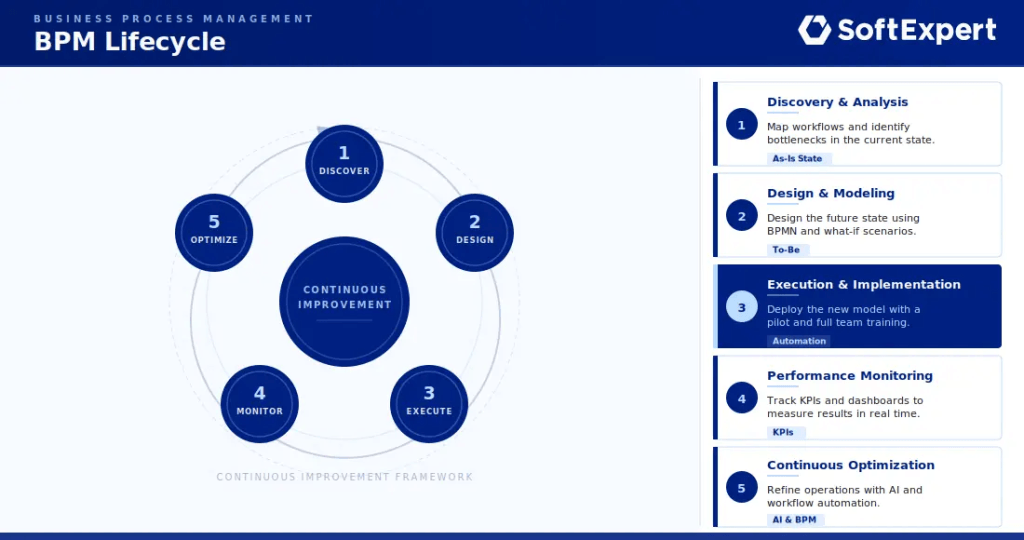
1. Discover and analyze current workflows
The initial phase is entirely focused on understanding the current state of your business. Your teams should map existing workflows to identify persistent bottlenecks, unnecessary redundancies, and areas with improvement potential.
Managers should establish baseline metrics before making any major operational changes. These initial figures provide a clear benchmark for measuring future progress accurately.
2. Design and model future states
The BPM planning team should use the data collected to create the ideal future-state process. To define it, teams can rely on standardized visual representations, such as BPMN, to map the new operational flow clearly.
The planning team should also run multiple what-if scenarios to anticipate potential issues before moving forward. This stage also requires defining new business rules, assigning task owners, and setting realistic timelines.
3. Execute and implement new systems
The third stage involves putting the newly designed process model into action within your organization. It is common for teams to run a proof of concept with a limited group in order to test functionality safely.
Successful execution requires comprehensive employee training based on updated procedures. Once that preparation is complete, your company is ready to roll out the changes systematically through manual or automated channels.
4. Monitor and measure performance
Your organization should monitor the performance of the new process against previously established business objectives. Leaders should define Key Performance Indicators (KPIs) to assess the overall success of the updated workflow.
Managers should use analytics dashboards to track efficiency, measure cycle times, and record error rate history. This continuous stream of data highlights how each new system performs under normal operating conditions.
5. Optimize and refine operations
The final stage focuses on continuous improvement based directly on monitored data. Your teams should adjust operations to respond to market shifts or internal organizational changes.
Your company should apply workflow automation wherever possible to reduce manual work. Maintaining a culture of ongoing optimization helps ensure the system remains efficient over the long term.
Solutions like SoftExpert BPM support these continuous improvement initiatives through centralized process mapping and AI-powered automation capabilities. Implementing a platform like this helps your organization monitor performance in real time and maintain regulatory compliance across departments.

What is the difference between BPM, BPMS, and RPA?
If you have ever confused the management methodology with the technical tools used to execute it, do not worry, you are not alone. That is exactly why we are breaking down the differences between BPM, BPMS, and RPA.
With a clear understanding of these terms, your organization can confidently choose the right approach for its operational needs.
What is BPMS?
Business Process Management Software (BPMS) refers to the technology suite used to automate, execute, and monitor business processes. The industry is currently shifting toward more intuitive low-code and no-code tools.
These modern solutions empower organizations to build applications without relying too heavily on specialized development teams. Companies evaluating these systems should prioritize the following capabilities:
- Visual modeling. The use of the BPMN 2.0 industry standard should allow workflows to be built and modified simply by dragging and dropping visual elements in an intuitive interface.
- No-code electronic forms. User interfaces for data entry and interaction should be created visually and integrated directly into workflows, ensuring faster implementation.
- Accessible intelligent automation. Business rules, approval routes, and exception management should be configured through logical menus and parameter settings, eliminating the need to write code.
What is the difference between BPM and Workflow Management?
Understanding the fundamental difference in scope between these two concepts helps prevent common implementation mistakes. Workflow management handles specific sequences of tasks designed to achieve a localized operational goal.
By contrast, BPM is a broader management discipline that analyzes end-to-end organizational efficiency across multiple departments. This holistic approach connects multiple individual workflows to optimize the entire business ecosystem.
What is the difference between BPM and Robotic Process Automation (RPA)?
Robotic Process Automation (RPA) uses software bots to mimic what a person would do at a keyboard, performing highly repetitive administrative tasks.
These specialized bots operate effectively within the broader system framework established by the core management methodology. The BPM platform manages the full workflow in which both human employees and bots operate.

Read more articles like this:
- 6 Essential Resources on Low-Code BPM Platforms
- Process mapping: what it is, benefits, and how to do it
- 9 best BPM software: what are they and how to choose?
- BPMS – Discover what it is and how to implement it in your business
- Process modeling and the role of BPM in new ways of working
Conclusion
Business Process Management shapes how modern organizations run their day-to-day operations by shifting the focus from isolated tasks to end-to-end workflows. This methodology aligns people, systems, and enterprise data to support critical strategic outcomes.
Teams that follow the standard five-stage lifecycle can continuously monitor and refine their operations based on accurate performance metrics. This commitment to ongoing optimization naturally drives greater business agility, significant cost reductions, and better experiences for both employees and customers.
Executing this complex strategy requires the right technology tools, such as modern BPMS platforms and targeted automation capabilities. Adopting intuitive low-code or no-code solutions enables business departments to model, implement, and govern their processes efficiently without demanding major development efforts.
Looking for more efficiency and compliance in your operations? Our experts can help identify the best strategies for your company with SoftExpert solutions. Contact us today!
FAQ – Frequently Asked Questions About Business Process Management (BPM)
Read the answers to the most common questions about Business Process Management (BPM) in the FAQ below.
BPM is a continuous management discipline that analyzes, organizes, and optimizes end-to-end workflows. It aligns people, systems, and data to improve efficiency and achieve corporate strategic goals.
Project management focuses on temporary initiatives with defined start and end dates. BPM, on the other hand, focuses on ongoing, repeatable organizational workflows that require continuous optimization over time.
BPM is generally categorized into three main types based on the nature of the workflow: people-centric (approval-driven), document-centric (document routing), and integration-centric (data exchange between systems).
The BPM lifecycle is a continuous improvement framework that typically consists of five stages: discover and analyze, design and model, execute and implement, monitor and measure, and optimize and refine.
Adopting BPM improves operational efficiency, reduces business costs, increases organizational agility, strengthens regulatory compliance, and enhances both employee and customer experiences.
BPMS stands for Business Process Management Software. It is the technology platform or suite used to model, execute, automate, and monitor business processes effectively.
Workflow management handles specific, localized task sequences designed to achieve a single objective. BPM is a broader, more holistic discipline that analyzes and optimizes end-to-end organizational efficiency across departments.
RPA (Robotic Process Automation) uses software bots to automate manual, highly repetitive, task-level actions. BPM is the broader management framework that orchestrates the full end-to-end workflow in which both bots and people operate.
No. While large organizations use BPM to connect complex systems, small and midsize businesses also benefit significantly from BPM to scale operations, reduce unnecessary costs, and standardize daily workflows.