Food Safety System Certification (FSSC 22000) is a globally recognized framework that audits and verifies the safety of processes across the food supply chain. Organizations face constant pressure to deliver safe products, making a trusted certification essential to protect both consumer health and brand reputation.
The main purpose of Food Safety System Certification (FSSC) is to help companies prevent contamination risks at every stage of production and logistics. By establishing rigorous operational standards, organizations can identify vulnerabilities before they affect the final product.
Achieving this certification demonstrates a strong commitment to quality and operational transparency in international markets. Leading retailers and global buyers often require this standard to ensure their suppliers meet strict safety criteria.
Follow along to learn more about FSSC 22000, how it differs from ISO 22000, and what your company needs to do to achieve certification.

What is the origin of FSSC 22000?
The FSSC 22000 scheme was created in 2009 to provide an auditable, highly technical model for the food industry. It was developed in response to industry demand for a more comprehensive framework capable of addressing specific operational risks more effectively.
Earlier generic standards such as ISO 22000 and ISO 9001 did not include the detailed prerequisite programs needed to manage complex food safety hazards. The Foundation for Food Safety Certification introduced this model specifically to close those regulatory gaps.
GFSI recognition and global acceptance
The Global Food Safety Initiative (GFSI) fully recognized the certification in 2010, and it is now considered a trusted standard for hazard management. This international endorsement helps build the level of trust required in complex global supply chains.
GFSI recognition has made the framework widely accepted by major global retailers and leading consumer brands. Organizations rely on this validation to meet strict procurement requirements across multiple regions:
- Standardized audits reduce the need for multiple redundant inspections.
- Clear compliance guidelines simplify international business relationships.
- Verified hazard control protocols protect both buyers and end consumers.
Customers around the world require consistent safety measures before signing purchasing agreements. A GFSI-recognized certificate provides the validation needed to meet a wide range of demanding international requirements.
Read more: What is the HACCP system and how can you create your food safety strategy
What are the main components of the FSSC 22000 scheme?
The certification scheme is built on three pillars that ensure a comprehensive approach to hazard management. A clear structure divided into well-defined parts helps organizations understand what auditors assess during the certification process.
The full framework consists of a management system, sector-specific technical specifications, and scheme-specific requirements. These three elements work together to create an effective and unified audit model:
- Management system: This creates the foundation for planning and operating safe food processes. This core pillar incorporates the internationally recognized ISO 22000 standard as well as hazard analysis principles.
- Sector-specific technical specifications: These provide targeted operational guidelines tailored to different supply chain segments. These prerequisite programs control critical environmental conditions and day-to-day hygiene requirements.
- Scheme-specific requirements: These ensure certification integrity by addressing modern industry challenges. These specialized criteria cover critical areas such as food fraud mitigation and strict allergen management.
ISO 22000 and HACCP
The international ISO 22000 standard serves as the foundation for the entire food safety management system. It provides the core structure needed to plan, implement, and operate safe production processes.
It is a foundational standard that fully integrates with the Hazard Analysis and Critical Control Points (HACCP) system. This integration enables organizations to identify and control biological, chemical, and physical hazards.
Prerequisite Programs (PRPs)
Prerequisite Programs provide the detailed technical specifications required to maintain safe operating conditions for each sector. These guidelines belong to the ISO/TS 22000 series, which adapts requirements to different segments such as manufacturing or catering.
Additional FSSC requirements
The FSSC Foundation established additional specific rules to ensure certification integrity and consistency. These extra criteria address modern industry challenges and align the scheme with global sustainability goals.
Auditors must verify several critical areas beyond the standard management system and prerequisite programs. The main additional requirements include the following specialized control measures:
- food fraud mitigation and vulnerability assessments;
- food defense plans to protect against intentional contamination;
- allergen management protocols to prevent cross-contamination;
- the establishment and promotion of a positive food safety culture.

What is the difference between FSSC 22000 and ISO 22000?
The FSSC 22000 scheme fully incorporates the ISO 22000 standard while adding mandatory prerequisite programs and scheme-specific organizational requirements. However, companies seeking to strengthen their existing protocols need to understand the structural differences between these two approaches.
For your organization to improve its current protocols, leadership must fully understand the structural differences between these two models. The main distinctions center on the depth of operational control and international market acceptance:
- ISO 22000: provides a foundational management framework without detailing sector-specific environmental prerequisite requirements.
- FSSC 22000: builds on the ISO 22000 foundation by requiring strict adherence to sector-specific technical specifications as well as additional integrity rules. The FSSC scheme is formally recognized by GFSI, which ISO 22000 is not.
This Global Food Safety Initiative recognition plays a critical role in international supply chain supplier negotiations and vendor approvals. Major retailers typically require a GFSI-benchmarked certificate before approving new suppliers for their commercial operations.
What applications and industries does FSSC 22000 cover?
The scope of FSSC 22000 extends far beyond traditional food processing facilities, as it covers the entire supply chain. This allows certified organizations to maintain strict safety protocols across multiple stages of operation, from raw material origin to the final consumer.
Your organization can use a transparent categorization system to determine whether your specific business qualifies for FSSC. The framework applies to several distinct industries, including:
Food and beverage manufacturing
This is the most common area of application for the management framework. It covers facilities that process perishable products such as dairy and meat, as well as biochemical products and shelf-stable goods.
Animal nutrition and pet food
The safety of what animals consume directly impacts the integrity of the human food chain. Facilities that produce feed for animals, whether companion animals or livestock, must implement strong controls to ensure traceability across different species.
These specialized plants also require robust cross-contamination prevention controls. This level of control protects both animal health and the broader agriculture and livestock ecosystem.
Food packaging manufacturing
This category covers the production of primary packaging materials, meaning packaging that comes into direct contact with food products. Manufacturing facilities must maintain strict hygiene requirements to prevent contamination during production.
Companies must control specific risks associated with materials such as plastics, glass, paper, and metal. During inspections, auditors assess the effectiveness of several critical preventive measures:
- monitoring the migration of chemical substances from packaging into the product;
- preventing foreign body contamination from glass or metal fragments;
- managing physical storage conditions to prevent moisture buildup in paper-based materials.
Transport, storage, and catering
The final stages of the supply chain involve complex logistics and direct catering services. These operations require meticulous temperature control to preserve the safety of perishable items during transport.
Organizations managing distribution centers must ensure proper product segregation to avoid potential contamination. Fleet managers are also responsible for maintaining regular vehicle cleaning.
Continue reading: BRCGS: understand how this standard protects food safety
What are the benefits of FSSC 22000 certification?
Achieving this certification delivers tangible operational benefits for both internal processes and external commercial performance. Organizations adopt this framework to refine day-to-day operations while expanding their market presence.
Risk management and customer trust
The standard protects both your brand reputation and the end consumer by establishing rigorous preventive measures. These demanding protocols help reduce food safety breaches across the production line.
Companies use this framework to maintain operational integrity through a range of risk management strategies. This certification process supports specific protective actions such as:
- improved product traceability, reducing the risk and cost of recalls;
- ensuring legal compliance across multiple regulatory jurisdictions;
- building a strong foundation for long-term consumer trust.
Access to the global market
FSSC 22000 acts as a commercial passport for companies seeking international expansion. This widely accepted credential makes it significantly easier to meet the strict procurement requirements of major retailers.
Certified suppliers are able to win more business in highly regulated global markets. Buyers actively seek certified partners to ensure the safety of their entire distribution network.
Integration with other ISO standards
The scheme includes a High-Level Structure (HLS) that promotes operational efficiency within the organization. This architecture makes it easier to integrate with other important management systems.
Your facilities can easily combine food safety criteria with ISO 9001 for quality management and ISO 14001 for environmental management. Conducting these unified assessments plays an important role in reducing the number of audits your teams need to face.
What changed in FSSC 22000 Version 6?
The latest changes to the scheme were published in April 2023, starting a 12-month transition period. The updated requirements officially came into effect on April 1, 2024.
This necessary update introduced significant structural revisions to align operations with the UN Sustainable Development Goals (SDGs). The Foundation for Food Safety Certification designed these changes to help organizations become more sustainable.
Realignment of food chain categories
The new framework introduced critical changes for specific industry categories, based on ISO 22003-1:2022. These structural adjustments enable more precise classification aligned with modern manufacturing facilities.
This realignment process includes the addition of new classifications, such as:
- Category BIII (handling of plant products before processing): covers activities involving plants and vegetables immediately after harvest, before industrial processing begins. This includes basic packhouse processes such as washing, sorting, grading, and cooling fresh fruits and vegetables.
- Category C0 (primary conversion of animals): covers the first stage of transforming animals after the farming phase. It includes primary slaughterhouse and meat processing operations such as slaughter, evisceration, and carcass chilling before the meat is sent for further processed product manufacturing.
- Category FII (trading and brokering): intended for companies that buy and sell food products without physically handling or storing them. It includes brokers, importers, and commercial intermediaries that facilitate trade and product flow in the global market.
- Pet food production categories were previously separate, but are now integrated into broader existing manufacturing classifications. The updated scheme evaluates these animal consumption products within categories C and D, alongside other standard processing operations.
- Transport and storage operations have been consolidated into a single classification formally designated as category G. This strategic consolidation simplifies the audit process for logistics providers managing both the movement and storage of consumable products.
Learn more: What is ISO 22002:2025 – Food Safety Prerequisite Programs (PPRs)
Stronger requirements and SDGs
Version 6 introduces new technical demands for certified organizations to promote sustainable and safe production methods. These strengthened requirements directly support the integration of the UN SDGs into daily operations.
Facilities must now implement documented policies related to food loss and waste reduction. Auditors will also assess the safe use of packaging made from recyclable materials within the production cycle.
FSSC 22000 Version 6 requires a broader approach to overall quality control throughout the facility. Organizations must also establish environmental monitoring programs to prevent biological contamination.
Continue reading: What is Halal Certification and how to obtain the certificate
Step by step to achieve FSSC 22000 certification
Organizations should follow a clear chronological path to build a robust food safety management system. This journey begins with implementing core requirements and conducting internal assessments.
Facilities that already hold ISO 22000 certification have a significant advantage at the start of this process. These companies should consider upgrading their credentials by integrating sector-specific prerequisite programs along with the additional FSSC 22000 requirements.
If your company decides to move forward with certification enhancement, it should follow these steps:
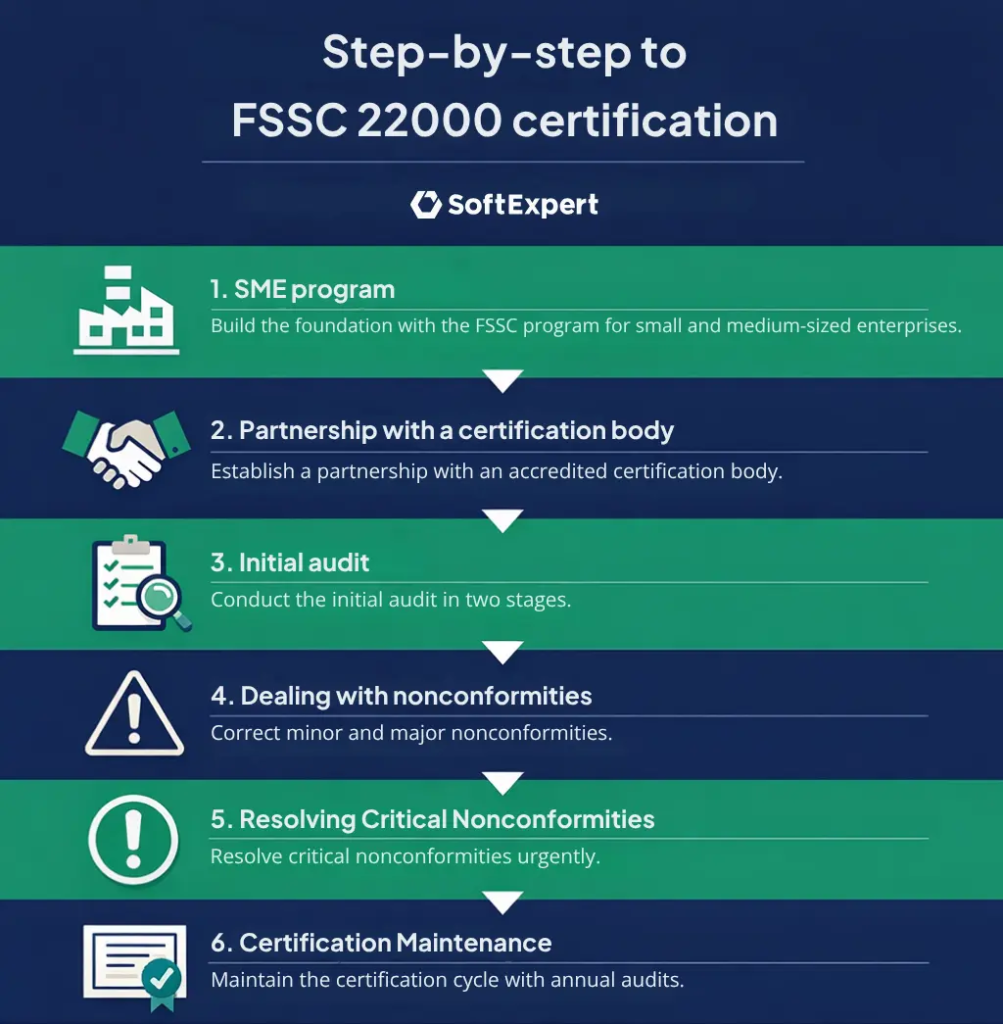
- Build your foundation with the FSSC Development Program for SMEs: Small and medium-sized enterprises can use a flexible, two-level, non-accredited pathway to develop their internal food safety systems.
- Partner with a certification body: The formal assessment process requires organizations to work with an accredited certification body. This critical relationship begins with a detailed gap analysis and the completion of the necessary internal preparation.
- Complete the initial audit: After the preparation phase, the facility must undergo a mandatory initial audit to verify operational compliance. Assessors divide this inspection into two distinct stages to thoroughly review the management system.
- Address minor and major nonconformities: Auditors use a classification system to categorize identified issues, which facility managers must resolve within a defined timeframe. Minor nonconformities do not immediately affect system performance, while major nonconformities directly impact the organization’s ability to achieve the intended food safety outcomes.
- Resolve critical nonconformities: Inspectors issue critical nonconformities when they observe situations in which food safety is being directly compromised during the facility inspection. Your company must take immediate action to resolve these severe issues before the certification process can continue.
- Maintain the certification cycle: Once the assessment is successfully completed, your organization receives a formal certificate that remains valid for a standard three-year cycle. Certified facilities must undergo annual surveillance audits to ensure they consistently maintain the required safety standards over time.
You can rely on SoftExpert to ensure compliance and maximize food safety efficiency in your organization. Our solutions help your company achieve the certification you need and maintain ongoing compliance with FSSC 22000.

Read more articles like this:
- What is ISO 22002:2025 – Food Safety Prerequisite Programs (PPRs)
- BRCGS: understand how this standard protects food safety
- ISO 22000 or FSSC 22000? See the differences
- What is GFSI and what is its role in food safety
- What is the HACCP system and how can you create your food safety strategy
Conclusion
Achieving FSSC 22000 certification demonstrates a strong commitment to protecting global food supply chains. This robust framework is built on the foundation of ISO 22000, but stands out by requiring strict adherence to sector-specific prerequisite programs.
Organizations that adopt these standards effectively reduce contamination risks while building lasting consumer trust. Formal GFSI recognition also acts as a valuable commercial passport, helping companies access new international markets.
Version 6 updates ensure that certified facilities align their daily manufacturing operations with global sustainability goals. Facility leaders can successfully navigate this rigorous audit process by implementing structured and reliable management systems.
Looking for more efficiency and compliance in your operations? Our experts can help identify the best strategies for your company with SoftExpert solutions. Contact us today!
FAQ – Frequently asked questions about FSSC 22000
Which industries can apply for certification? How long is the certificate valid? Are small and medium-sized businesses included? You’ll find the answers to these and other common questions below.
It is a globally recognized certification scheme that audits food safety processes. It helps organizations manage contamination risks throughout the supply chain through rigorous operational standards.
FSSC 22000 incorporates the ISO 22000 framework but adds mandatory prerequisite programs and scheme-specific rules. In addition, it has formal GFSI recognition, which ISO 22000 does not have on its own.
Yes. The Global Food Safety Initiative fully recognizes this standard. This international endorsement helps organizations meet the strict procurement requirements of major global retailers.
The scope covers multiple stages of the supply chain. It applies to food and beverage processing, animal feed production, primary packaging manufacturing, transportation, storage, and food service operations.
Version 6 restructured supply chain categories and introduced technical requirements to support the UN Sustainable Development Goals. Facilities must now address food loss and waste, as well as environmental monitoring.
A successful initial audit grants a certificate valid for three years. Certified facilities must undergo annual surveillance audits during that cycle to maintain approved status.
Yes. The scheme offers a Development Program specifically designed for small and medium-sized businesses. This flexible pathway helps growing companies build their safety systems progressively.