Sustainable development means improving people’s lives today while protecting the planet and its resources for future generations. According to the classic Brundtland Report (1987) from the World Commission on Environment and Development, this approach means meeting current needs without compromising future generations.
Historically, companies viewed environmental and social initiatives as voluntary Corporate Social Responsibility (CSR) programs. However, this has changed, and modern businesses now align their operations with the United Nations (UN) 17 Sustainable Development Goals (SDGs).
This global shift has transformed what were once optional philanthropic ideas into corporate sustainability strategies. Investors and regulatory agencies want to see responsible environmental and social actions in practice.
The major challenge for companies is turning theoretical sustainability concepts into concrete numbers. Leaders must track exact metrics to demonstrate progress and comply with new global accountability rules.

The three core pillars of corporate reporting
Sustainable development relies on a precise balance among the environmental, social, and economic pillars. Companies use these three pillars to measure their real impact and generate performance data.
Managers must evaluate sustainability based on the following points:
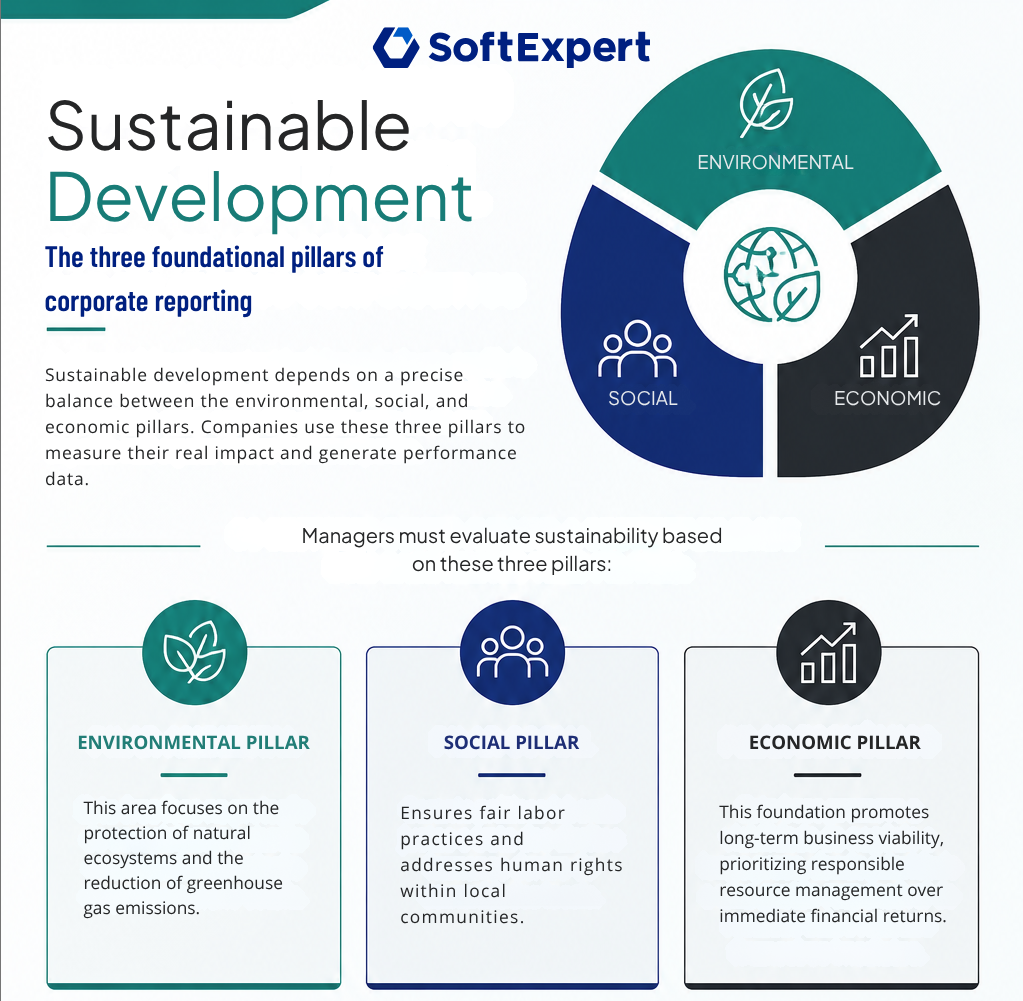
- Environmental pillar: This area focuses on protecting natural ecosystems and reducing greenhouse gas emissions.
- Social pillar: This ensures fair labor practices and addresses human rights within local communities.
- Economic pillar: This foundation promotes long-term business viability, prioritizing responsible resource management over immediate financial returns.
Current reporting standards translate these three pillars into Environmental, Social, and Governance (ESG) criteria. The governance aspect specifically ensures that the board takes responsibility for environmental and social impacts.
An organization risks severe reputational damage if it decides to promote itself as sustainable without having precise metrics. Known as greenwashing, this practice occurs when a company claims to support sustainable development but lacks the data to back it up.
Read more: How to build a materiality matrix in 5 Steps
CSRD, GRI, TCFD, and ISSB: The different sustainable development frameworks
As mentioned, companies must navigate a market transitioning toward stricter regulatory demands. To successfully comply with these new rules, your organization relies on the core concept of materiality.
Materiality assesses how sustainability issues impact a company’s finances and how the organization impacts the world around it. Standardized frameworks use this concept to help managers actively prove their sustainable development progress.
Global Reporting Initiative (GRI)
The Global Reporting Initiative (GRI) serves as a voluntary framework for international organizations. The system has a high adoption rate and measures the impact on multiple stakeholders by analyzing how a company’s operations can affect the economy, the environment, and local populations.
Task Force on Climate-related Financial Disclosures (TCFD)
The Task Force on Climate-related Financial Disclosures addresses the financial risks associated with global climate change. This model adopts an outside-in perspective, showing how climate events affect the financial stability of companies.
Recently, the way the business world applies these climate recommendations has transformed. The International Sustainability Standards Board, which we will discuss next, is absorbing and consolidating the original TCFD guidelines.
International Sustainability Standards Board (ISSB)
The International Sustainability Standards Board has established a new global baseline for investor-focused sustainability reporting. Examples of this are the IFRS S1 and IFRS S2 standards, which unify companies’ financial disclosures.
These standards are designed for global investors and financial capital markets that demand highly specialized data. Financial stakeholders use these metrics to compare sustainable development progress across different international markets.
Read more: IFRS and GRI: an agreement that only offers benefits in the context of ESG
Corporate Sustainability Reporting Directive (CSRD)
The Corporate Sustainability Reporting Directive (CSRD) is a European regulation with significant global consequences. This directive went into effect in 2024 for large companies in the European Union and sets strict compliance rules that are subject to auditing.
Read more: CSRD: everything you need to know about the new European Union (EU) directive
These rigorous European requirements directly affect global supply chains and international partner organizations. The regulation firmly applies the concept of double materiality through two main tracking categories:
- Organizations track the specific financial risks that climate change and social issues impose on businesses.
- Companies simultaneously measure the external impacts their daily operations create on the environment and society.
Which sustainable development framework should I adopt?
Corporate managers face a complex decision when choosing the most suitable sustainability reporting standard for their operations. They must align their chosen strategy with the organization’s specific profile and business goals.
It is necessary to evaluate your company’s size, industry sector, and target market to determine the exact path for your reporting. The following guidelines help team leaders navigate the current regulatory landscape:
- If your company operates in the European Union or supplies organizations within the bloc, CSRD compliance is mandatory.
- If your organization primarily targets global investors, adopting ISSB and TCFD standards is essential.
- If your leadership team seeks broad transparency with stakeholders, the GRI framework offers a more comprehensive approach.
In practice, these different standards share common metrics and have overlapping data requirements. Your teams should use these frameworks complementarily, rather than as competing standards.
A company can use GRI for public transparency with the community while simultaneously applying ISSB standards for financial stakeholders. This integrated approach creates a unified reporting strategy that satisfies different audiences at the same time.
How to centralize indicators in sustainable development practices
Managing scattered and overlapping data can become a massive operational challenge for corporate teams. Add to this the management of carbon footprints and social metrics across multiple departments, and you will see that manual data collection processes cannot meet the rigorous requirements of different reporting frameworks simultaneously.
To address this issue, one solution is SoftExpert ESG, which helps centralize the complex indicators required by frameworks like GRI and CSRD into a single automated management platform. The software consolidates environmental and social data from across your company, establishing a highly objective reporting process.
Intelligent automation has the potential to radically transform how corporate leaders manage their sustainability goals and the disclosures required by regulatory frameworks. Implementing a digital management system provides the following operational improvements for reporting teams:
- Automated data collection significantly reduces human error in calculating complex metrics.
- Centralized information aids in compliance and readiness for future regulatory audits.
- Streamlined workflows turn sustainable development from a bureaucratic burden into a strategic asset.
Corporate leaders need accurate information to prove their commitment to global sustainability goals. A centralized technological approach enables organizations to meet these international demands with transparency and precision.

Conclusion
The modern corporate landscape has left voluntary CSR (Corporate Social Responsibility) actions behind in favor of structured ESG strategies aligned with the UN Sustainable Development Goals. Balancing the environmental, social, and economic pillars is no longer an option: companies must provide concrete data to back their claims and avoid the severe reputational risks associated with greenwashing.
Navigating global frameworks like GRI, ISSB, and the European CSRD requires a deep understanding of double materiality to cater to both financial investors and other societal stakeholders. Rather than viewing these regulations as competing requirements, organizations should use them complementarily to build a unified and transparent reporting strategy.
Adopting specialized technological solutions, such as SoftExpert ESG, is essential to centralize scattered indicators and eliminate human error in complex metrics. By automating data collection, companies can easily prepare for rigorous regulatory audits and turn sustainability into a powerful strategic asset.
Looking for more efficiency and compliance in your operations? Our experts can help identify the best strategies for your company with SoftExpert solutions. Contact us today!
FAQ: Questions about sustainable development
Want to learn more about the pillars and importance of sustainable development? Curious about greenwashing? You will find this and much more in our frequently asked questions section!
It means improving the quality of life today while protecting the planet and resources for future generations. This approach balances present needs without compromising the future.
The three fundamental pillars are environmental, social, and economic. They guide corporate reporting and translate directly into modern Environmental, Social, and Governance (ESG) criteria.
It promotes long-term business viability over immediate financial return. Adopting these practices helps companies meet regulatory requirements, attract investors, and avoid reputational damage.
Greenwashing occurs when a company claims to support sustainable development but lacks the exact metrics and data to prove its environmental or social progress to stakeholders.
The choice depends on your size, industry, and the market you operate in. Use CSRD for European operations, ISSB or TCFD for global investors, and GRI for broad stakeholder transparency. They are usually complementary.
The 17 SDGs are not legally binding. However, countries and modern companies adopt them as a baseline to structure their sustainability strategies and align their operations with global targets.
Unchecked climate change threatens public health, food security, and economic stability. Investing in sustainable practices reduces greenhouse gas emissions and strengthens climate resilience.
Tools like SoftExpert ESG automate data collection across various departments. This centralizes complex metrics for GRI and CSRD, reducing human error and preparing companies for audits.