An AI maturity assessment is a diagnostic tool that measures your organization’s readiness to adopt and scale Artificial Intelligence across its operations. This analysis maps your company’s exact position on its journey, helping you transition from isolated pilot projects to generating real business value.
Organizations achieve better results when they integrate Artificial Intelligence as part of the strategic resources at their disposal. This allows these technologies to be used to process information more intelligently and support decision-making at all levels of the enterprise.
Many companies experiment with informal machine learning models without ever realizing a return on their initial investments. In contrast, a future-ready organization embeds these technologies deeply into its core strategy, daily workflows, and corporate governance structure.
Assessing your current stage brings the clarity needed to create a realistic and secure roadmap for technological transformation. Leaders can use this baseline to prioritize next steps and align initiatives with the company’s long-term objectives.

Why Should I Assess My AI Maturity?
Evaluating your current technological state prevents you from investing in the wrong areas and provides a clear path to measurable returns. Research from MIT Sloan indicates that companies with advanced technological capabilities tend to financially outperform their industry peers.
Organizations frequently struggle to move beyond initial experiments, falling into what experts call the “pilot trap.” Studies by MIT Sloan and the Boston Consulting Group show that seven out of ten companies report minimal impact or zero return from their Artificial Intelligence initiatives.
Skipping the diagnostic phase increases the risk of ending up with isolated projects scattered across different departments. Consequently, the likelihood that most of them will fail rises exponentially.
A well-structured AI maturity assessment project mitigates these operational risks by delivering the following strategic benefits:
- Alignment of organizational silos: Creating a shared understanding of goals between technical and business teams.
- Uncovering hidden bottlenecks: Identifying issues related to data quality or team readiness before implementation begins.
- Consolidating diagnostic data: Strengthening the business case to justify future technology investments to stakeholders.
Leaders require a realistic mapping of their current infrastructure to effectively plan upgrades. Through this objective analysis, you can build a competent strategy with clear priorities.
What Are the Seven Pillars of a Company’s AI Maturity Assessment?
To achieve optimal readiness for implementing Artificial Intelligence, your organization must combine strategic alignment, human development, and robust governance policies. You need to evaluate these seven fundamental areas to successfully scale these solutions:
1. Business Strategy Alignment
You will need executive sponsorship to secure the necessary resources to align new technologies with broader corporate objectives. Leaders must define a clear vision to guide adoption efforts across different departments.
A well-defined strategy prevents your teams from focusing on flawed experiments that will never deliver measurable results. With the right guidelines, your teams can prioritize the most important use cases, concentrating their efforts on high-value, highly feasible initiatives.
2. Data Foundations
High-quality information sources serve as the fuel for any successful Artificial Intelligence system. Organizations must establish accessible data repositories to ensure that models are trained on relevant and accurate materials.
Therefore, strong governance protocols are essential. They are responsible for maintaining the integrity of these assets over time. To achieve this, engineering teams must build robust pipelines to transform raw data into a curated selection of enterprise-ready assets.
3. Technology and Infrastructure
Modern systems require scalable computational power to process massive workflows efficiently. The Information Technology (IT) department must assess whether your infrastructure is cloud-ready, ensuring the architecture can support advanced models.
Application Programming Interface (API) integration capabilities allow different software environments to communicate seamlessly. Modernizing existing infrastructure prevents technical bottlenecks during large-scale enterprise deployments.
4. AI Governance and Security
Defining responsible policies protects your organization from ethical and legal complications. You need a comprehensive risk management framework capable of evaluating every project before it reaches production.
Strict data privacy protocols ensure that sensitive data remains secure during model training and execution. A governance board should oversee compliance with regional regulations to maintain safe and transparent operations.
5. Organization and Culture
Cultivating a data-driven mindset encourages your employees to rely on objective metrics rather than intuition alone. It is the role of leadership to facilitate cross-functional collaboration, bringing technical teams and business units closer together.
A culture that embraces change reduces the natural resistance to automated workflows and new daily routines. Basic AI literacy programs help your workforce understand how to interact effectively with intelligent tools.
6. Skills and Talent
To build advanced technological capabilities, you need professionals with expertise in data science and engineering. Your Human Resources (HR) department must develop targeted recruitment strategies to attract highly qualified talent.
Your company also needs to invest in internal training programs to upskill your current workforce for new technical roles. A continuous learning environment ensures your team stays up to date with rapidly evolving industry practices.
7. Model Management and Value Realization
Managing the full lifecycle of a model involves strict monitoring from the initial prototype to final production. Engineering teams must track system performance to prevent results from deteriorating over time.
Calculating the Return on Investment (ROI) confirms that deployed solutions generate real financial value. This ensures that every implemented technology contributes to concrete business outcomes.

What Are the Stages of the AI Maturity Journey?
To identify your organization’s current position, it is essential to understand how technology adoption progresses. Companies generally advance through several progressive levels as they expand their Artificial Intelligence capabilities.
These are the stages of the AI maturity journey:
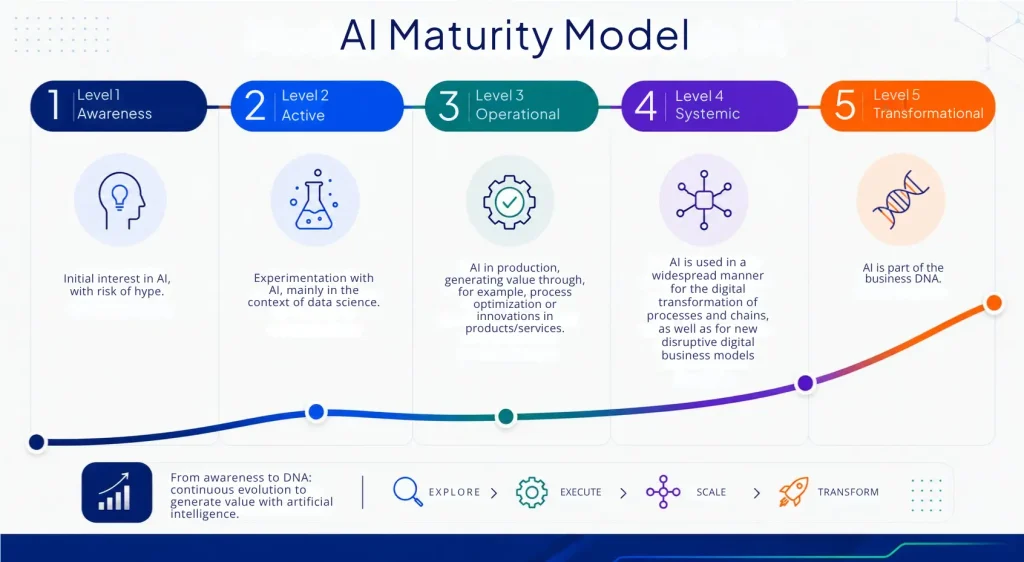
- Stage 1: Focuses on initial awareness and occasional experimentation without enterprise-wide standardization.
- Stage 2: Involves building specific pilots and testing models to prove initial value.
- Stage 3: Focuses on deeply embedding automated tools and machine learning into daily workflows.
- Stage 4: Scales solutions across multiple critical workflows through an integrated technology infrastructure.
- Stage 5: Achieves a transformative state where intelligent systems reshape core strategies and decision-making.
Below, we explore each of these stages in more detail.
Stage 1: Awareness
The starting point consists primarily of isolated pilot projects operating without company-wide standardization. Teams work with a general lack of formal governance while focusing on building initial Artificial Intelligence (AI) awareness among employees.
Companies typically explore basic applications to resolve simple internal support challenges. These initial efforts help the workforce become more comfortable with automated tools before tackling complex operations.
Stage 2: Active Level
In this phase, organizations begin to prove the practical value of initiatives while establishing repeatable operational processes. Leadership teams shift from a traditional command-and-control culture to a more collaborative management style focused on coaching and communication.
Technical departments begin sharing data using Application Programming Interfaces (APIs) to break down information silos and improve connectivity. Engineers test various foundation models to determine which options best fit the company’s specific needs.
Stage 3: Operationalization and Scaling
Technology becomes deeply embedded in daily workflows during this maturity phase. Cross-functional teams deliver lasting value by redesigning legacy processes to maximize operational efficiency.
The organization adopts structured platforms and begins developing models trained on collected internal data. Managers also systematically track performance metrics to ensure investments deliver the expected financial returns.
Stage 4: Systemic Level
Solutions move beyond isolated experiments to power core strategic processes in a coordinated manner. Technical infrastructure and governance policies become standard practices adopted uniformly across different sectors.
This level ensures the company can anticipate compliance standards and mitigate security risks with agility. Consolidated data serves as the engine for decision-making and prepares teams to handle complex scaling demands.
Stage 5: Transformation and Future-Readiness
The ultimate goal is achieved when intelligent systems reshape core decision-making processes and rethink the business model. A company at this stage operates with an automation-first and data-processing mindset that has spread throughout the organization.
The infrastructure is present across all corporate layers and sustains continuous innovation with rapid adaptation to market changes. Some companies even package their advanced technical capabilities to sell them as entirely new enterprise services.
Continue reading – ISO 42001: All about the new standard for Artificial Intelligence
How to Conduct an AI Maturity Assessment
To execute an accurate Artificial Intelligence maturity assessment, you need strong cross-functional collaboration between technical and business leaders. Your company must avoid evaluating its IT department in a vacuum, or it risks receiving inaccurate results.
A structured analysis needs to follow three specific steps to turn raw data into an actionable execution plan:
- Step 1 focuses on mapping the current state and benchmarking technical capabilities against market standards.
- Step 2 requires teams to consciously prioritize specific areas and deprioritize others.
- Step 3 involves developing a chronological roadmap for the entire year.
1. Map the Current State and Benchmark
Your organization should use targeted surveys and internal health checks to establish a clear baseline of your current infrastructure. This initial phase evaluates the Artificial Intelligence models currently in operation, as well as all active technical programs.
Leaders must then compare their progress against direct competitors to identify immediate gaps in their operations. These peer comparisons provide valuable context for understanding industry standards and broader technology trends.
2. Prioritize Focus Areas and Deprioritize the Rest
Assessment data forces leadership teams to make difficult decisions about where to invest limited corporate resources. Key departments must reach a consensus to align their efforts around the most viable use cases.
Explicitly prioritizing key initiatives also means consciously deprioritizing other projects, thereby maintaining strategic focus. This approach prevents your teams from having to divide their attention across too many actions simultaneously.
3. Develop an Actionable 12-Month Roadmap
The final step translates assessment findings into a chronological execution plan for your company. Your teams should chart their technological progress in specific phases across a 12-month calendar.
For example, your company might define its technical vision in the first two months, followed by initial pilot projects from months three to five. Between months six and eight, leadership should focus on communicating the defined strategy and establishing clear adoption goals for the organization.
This mid-way phase is also ideal for launching formal Artificial Intelligence literacy programs to prepare the broader workforce. Simultaneously, technical departments should gain executive approval to evolve data processing capabilities and establish Machine Learning Operations (MLOps) practices.
Teams should introduce product management frameworks during this period to accurately track the value generated by early pilots. As the organization approaches the final quarter of the plan, managers should create a dedicated Center of Excellence to centralize technical expertise.
Infrastructure teams can then focus on configuring advanced monitoring between months nine and 12, ensuring long-term stability. A successful execution plan must always remain flexible enough to accommodate unexpected technical challenges or shifts in corporate priorities.
Conclusion
An Artificial Intelligence (AI) maturity assessment is an essential diagnostic tool for organizations looking to escape the pilot trap. This analysis allows your company to precisely identify its current stage of maturity and map key operational gaps before allocating financial resources.
To safely advance toward a transformative model, leadership must carefully evaluate the seven core pillars of enterprise readiness. This process requires strong cross-functional collaboration between technology teams and business units, ensuring alignment with long-term strategic goals.
Consolidating diagnostic results provides the foundation needed to build an actionable 12-month roadmap with clear priorities. By establishing this flexible timeline, your company can structure its technological capabilities and prepare its entire workforce for sustainable returns.
Looking for more efficiency and compliance in your operations? Our experts can help identify the best strategies for your company with SoftExpert solutions. Contact us today!
FAQ – Frequently Asked Questions About AI Maturity
Do you still have questions? Read through the top questions and answers on the topic:
It is a framework that evaluates a company’s ability to utilize Artificial Intelligence across its processes, identifying strengths and gaps to guide evolution from an experimental level to strategic and scalable usage.
It prevents misaligned investments and helps overcome the “pilot trap” that affects 70% of companies. The diagnostic aligns teams and builds a solid business case before beginning technological implementation.
The essential pillars are: business strategy alignment, data foundations, technology and infrastructure, governance and security, organization and culture, skills and talent, and model management for value realization.
Companies evolve through four core phases: Awareness and Experimentation (isolated pilots), Competency Building (repeatable processes), Operationalization (AI embedded into workflows), and Transformation (an “AI-first” mindset).
Divide the plan into chronological phases. Start by defining the technical vision in months 1-2, execute pilots in months 3-5, launch literacy programs in months 6-8, and establish advanced monitoring and observability in months 9-12.
They are autonomous systems that make decisions and execute complex tasks in real time with minimal human intervention. They utilize memory and planning to increase the company’s operational productivity.
It is the use of AI focused on solving environmental and ethical challenges. It involves optimizing resource usage, adopting energy-efficient computing, and applying practices like AI Trust, Risk and Security Management (TRiSM) to mitigate bias and protect data privacy.
The main obstacle is cultural. Approximately 92% of companies face barriers related to resistance to change and the lack of a data-driven mindset, which requires heavy investment in AI literacy.
The CoE centralizes the company’s technical expertise. It holds four primary roles: persuade (fund pilots), inform (list ideas), enforce (establish universal standards), and innovate (generate real business impact).
Implement a risk-based screening funnel to evaluate each project before production. Analyze purpose limitation, regulatory compliance, and ethical alignment through a dedicated governance board.