Commercial intelligence enables companies to strategically leverage the high volume of data generated by sales. Every phone call, sent proposal, scheduled meeting, and lost deal reveals something about the market, the customer, and the operation itself. Using a CRM for commercial intelligence starts right at this point: transforming scattered records into actionable insights that support every business decision.
Furthermore, much of this information resides in isolated spreadsheets, individual email inboxes, and notes that never reach management. When a sales representative leaves the company, that historical context leaves with them. When a manager needs to understand why a target was missed, the answer stems from intuition rather than data.
A CRM system solves part of the problem by centralizing records. The other part relies on integration. An isolated sales system only sees what happened up to contract signing and stops there, failing to connect with delivery, billing, and customer support, which is where much of the insight regarding profitability and retention resides.

What is commercial intelligence?
Commercial intelligence is the practice of gathering, organizing, and analyzing information about customers, competitors, and internal operational performance to guide sales decisions. It answers concrete questions: which segments close fastest, at what stage deals stall, which loss reasons recur most frequently, and how long a full sales cycle takes.
To build a comprehensive operational view, commercial intelligence relies on two complementary dimensions:
- Internal intelligence: Customer Relationship Management (CRM) systems track operational metrics such as sales team performance data, stage-by-stage conversion rates, and deal loss reasons. Analyzing these internal records enables leaders to identify funnel bottlenecks and refine daily sales execution.
- External (or market) intelligence: External research establishes market context by defining the Ideal Customer Profile (ICP), estimating Total Addressable Market (TAM), conducting competitor analysis, and guiding outbound prospecting. Combining these external signals helps organizations target qualified accounts and align commercial approaches with actual market demand.
The difference between data and intelligence lies in processing. A list of lost deals is data. Knowing that most of these losses concentrate in a specific segment and consistently occur at the exact same funnel stage is actionable information, and this level of insight changes how the team prioritizes its efforts.
To reach this level of insight, the data must meet a few key conditions:
- Be recorded using a standardized format so that different deals can be compared against one another;
- Be readily accessible to decision-makers without relying on manual exports and spreadsheet consolidation;
- Be capable of cross-referencing with data from other departments, such as billing, fulfillment, and customer success.
What is the role of CRM in commercial intelligence?
The CRM serves as the primary source of commercial data because it captures interactions as they happen. No monthly report can accurately reconstruct what was said in a meeting, which objection surfaced, or when a prospect requested an extension. Real-time logging preserves this context.
Beyond storage, the system organizes. It separates accounts from contacts, associates deals with pipeline stages, and tags activities with dates and assignees. This structure is what allows for counting, aggregating, and comparing data down the line. Without it, you are left with a text file too massive to read.
There is also a less obvious benefit. By requiring defined fields and stages, the CRM tool forces companies to explicitly outline their sales process. Many organizations only realize that every rep follows a different workflow when they try mapping the funnel in the system. Standardizing the process is a prerequisite for standardizing data.
What are the benefits of commercial intelligence for my company?
Implementing commercial intelligence enables organizations to transition from reactive sales approaches to data-driven growth strategies. By analyzing market signals alongside internal performance metrics, leadership teams can unlock measurable operational improvements.
Structured data analysis directly strengthens several key commercial performance indicators (KPIs) across the entire sales cycle. Companies utilizing these commercial insights typically see significant advancements in four core areas:
- Reduced Customer Acquisition Cost (CAC): Filtering unqualified prospects early prevents wasted sales effort and lowers Customer Acquisition Cost (CAC). Directing resources toward high-intent accounts allows teams to generate higher returns on prospecting investments.
- Revenue predictability: Tracking stage-by-stage conversion rates and historical deal patterns provides clearer visibility into future revenue streams for accurate sales forecasting. This structured visibility empowers executive teams to plan operational capacity and budget allocations with much greater confidence.
- Shorter sales cycles: Identifying buyer pain points before initial contact helps sales reps craft relevant proposals much faster. Addressing negotiation friction early accelerates deal closure timelines and keeps prospects moving smoothly through the funnel.
- Increased customer retention: Monitoring usage patterns and customer satisfaction signals helps account managers proactively prevent churn, improving retention. Expanding existing accounts through timely service upgrades increases the total Customer Lifetime Value (LTV) of each client relationship.
Ultimately, commercial intelligence transforms raw operational metrics into actionable business strategies that drive sustainable expansion. Organizations that adopt this disciplined approach position themselves for steady, resilient growth over time.
What data does a CRM organize and what does it reveal?
A few key data points drive nearly all the analytical value of a commercial system:
- Interaction history: Shows how many touchpoints are required to close a deal and which channels work best for each customer profile;
- Pipeline stages: Indicate where opportunities accumulate and which stage in the process bottlenecks the operation;
- Loss reasons: Reveal whether the recurring obstacle is pricing, delivery timeline, competition, or lack of product fit;
- Sales cycle length: Shows the average duration from initial contact to contract signing, segmented by industry, account size, and sales rep;
- Stage conversion rates: Allow teams to estimate how many opportunities must enter the funnel to hit revenue targets;
- Opportunity sources: Identify which demand-generation channels actually drive revenue.
In isolation, these metrics describe the past. When cross-referenced, they power sales forecasting. Knowing the conversion rate of each stage and the average sales cycle by segment enables revenue projections with a reasonable margin of error, allowing managers to adjust team focus before the quarter ends, not after.

Why integrate the CRM with other business processes?
A well-maintained CRM provides accurate insights about the sale itself, but yields little insight into what happens afterward. The deal size approved in the proposal is not always the billed amount. The customer who closed fastest might generate the highest volume of support tickets. The product with the highest conversion rate might yield the lowest margin. None of this is visible within the sales system alone.
That is precisely where integration elevates analysis quality. When the CRM communicates with the ERP, companies can compare what was sold against what was delivered and billed. Connecting to customer support reveals the cost to serve each customer profile. Meanwhile, linking to process and document management systems ties deals to approval workflows, contracts, and technical requirements triggered internally by the sale.
In regulated or highly technical sales environments, this last point carries even greater weight. An industrial proposal often depends on feasibility studies, discount approvals, technical documentation, and quality requirement logs. If the sales team operates in one system while these steps take place in another, information remains fragmented on both ends.
From a practical standpoint, integration depends on two factors. The first is technical: open APIs, pre-built connectors, or an integration layer that allows data exchange without custom development for every change. The second is organizational: clearly defined processes and standardized terminology across departments. Integrating systems over misaligned processes only spreads inconsistency faster.
Read more — Operational Efficiency and Compliance: Strategies to Align Growth and Compliance in Regulated Industries
CRM tools for commercial intelligence
Selecting the right solution depends on team size, sales model, and the reps’ capacity to maintain the system day-to-day. The options below cater to distinct operational needs:
1. Agendor CRM
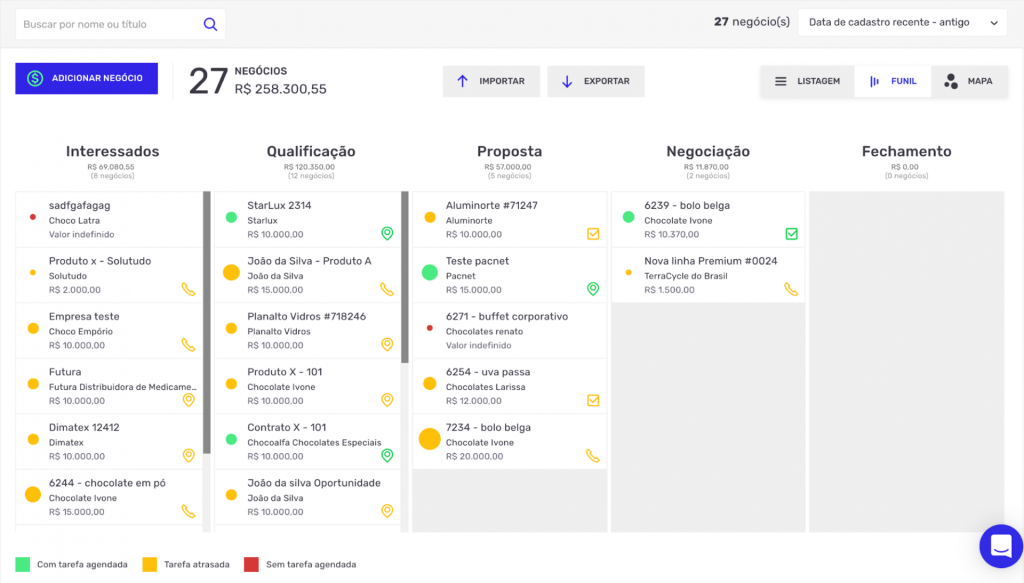
Agendor CRM is a Brazilian sales system with over ten years in the market, designed for B2B consultative sales teams. It suits companies looking to structure commercial intelligence by offering multiple sales pipelines, custom fields, and mandatory fields per funnel stage, a feature that tackles incomplete data entry at its root.
When a deal cannot move forward without segment, loss reason, or deal value filled in, reports become reliable. This is complemented by sales reporting and metrics, activity calendars, task automations, and intelligent next-step recommendations based on deal history.
The same logic applies to WhatsApp conversations, which often remain outside the CRM when reps use personal numbers. In this scenario, the platform automatically logs these chats directly into contact or company profiles without disrupting communication workflows. This enables managers to track client commitments without relying on rep summaries.
The platform also offers an open API for integration with ERPs, process management systems, and other corporate software, enabling companies to cross-reference sales data with billing, fulfillment, and post-sales service.
It also provides a free mobile app, ideal for field sales operations where interactions need to be logged immediately after a visit rather than at the end of the week.
Keep reading: BPMS – Discover what it is and how to implement it in your business
2. HubSpot Sales Hub
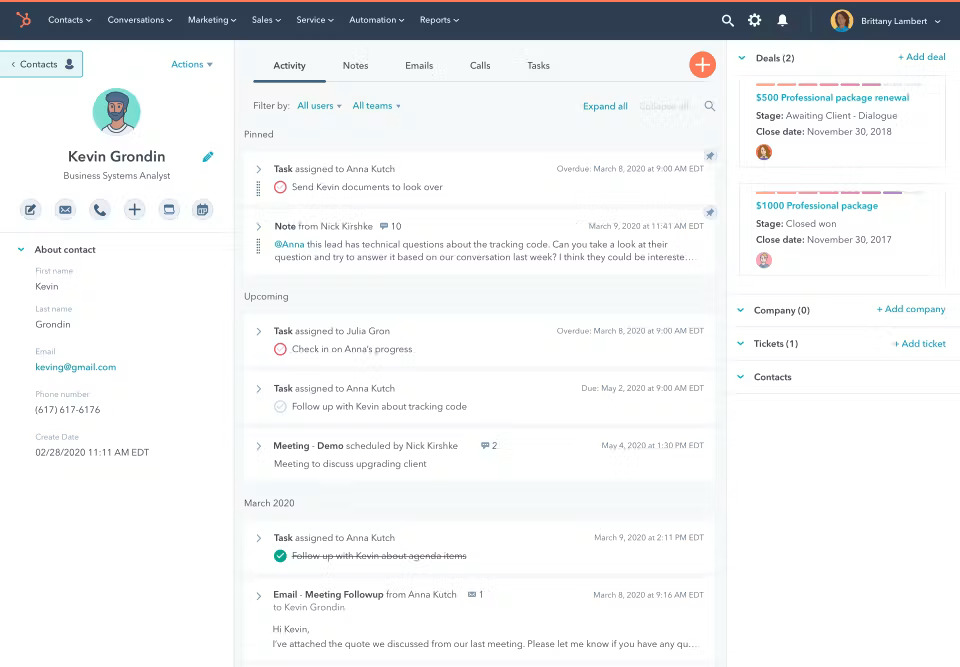
HubSpot Sales Hub excels at bridging marketing and sales. Because both teams share a single contact database, tracking opportunity origins and determining which demand-generation campaigns generate deals that actually progress through the funnel becomes seamless.
The interface is user-friendly, typically driving fast adoption. However, deeper analytical capabilities are locked behind higher-tier plans, requiring careful operational planning prior to procurement.
3. Zoho CRM
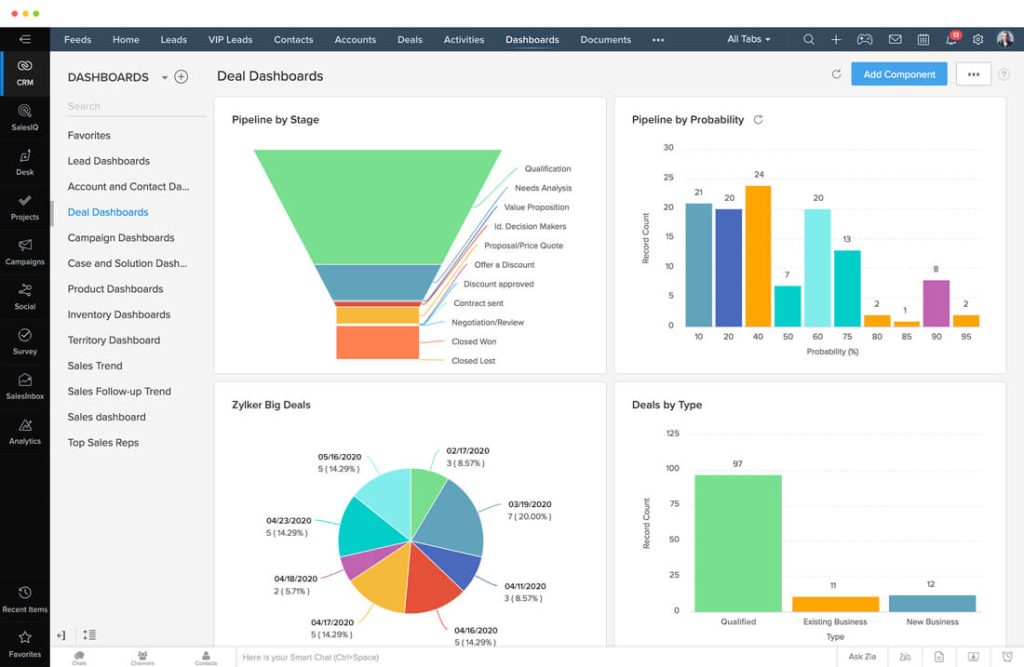
Zoho CRM offers a broad suite of customization and analytics features, including custom reports, user-specific dashboards, and AI capabilities for pattern recognition in deals. It integrates smoothly with other Zoho applications and external tools via API.
Its versatility is also its main drawback. The sheer volume of configurations can prolong implementation, and teams without dedicated setup resources often end up utilizing only a fraction of its capabilities.
How to choose the right CRM for your operation
A few key criteria help evaluate alternatives without getting bogged down in feature lists:
- Integration capabilities: Verify if an open API exists and if turnkey integrations are available for critical internal systems;
- Data entry quality: Custom and mandatory fields prevent reporting quality from relying solely on representative diligence;
- Native reporting: The fewer spreadsheet exports required, the more likely analysis becomes a routine management practice;
- Support and language: Local language support and aligned time zones reduce response times when operational blockers arise.
It is worth adding a frequently overlooked criterion: what the company currently tracks today. Switching tools without reviewing internal workflows simply reproduces the same incomplete data in a newer interface.

From Data to Decision
No system generates commercial intelligence on its own. A CRM provides the foundation—an organized, comparable log of customer interactions. What drives results is the process built around it: what reps log, the standards they follow, and how seamlessly that information flows between sales, operations, and finance.
Companies that treat CRM software as part of an integrated workflow answer questions that spreadsheets cannot—and do so in time to take action. Those that treat it merely as a contact book continue making decisions based on intuition. The path to establishing commercial intelligence begins by defining the key questions your operation needs to answer and auditing whether the necessary data is already being captured.
FAQ – Frequently Asked Questions about Commercial Intelligence
Below, you will find the most important answers about business intelligence.
Commercial intelligence is the practice of collecting, organizing, and analyzing internal sales data and external market information. It guides strategic sales decisions by revealing sales cycle lengths, stage bottlenecks, loss reasons, and customer buying patterns.
Internal intelligence focuses on operational metrics from Customer Relationship Management (CRM) tools, such as deal loss reasons and stage conversion rates. External intelligence examines market factors like the Ideal Customer Profile (ICP), Total Addressable Market (TAM), and competitors.
A Customer Relationship Management (CRM) system serves as the primary data source by recording sales interactions as they occur. It organizes pipeline stages, stores communication history, and standardizes commercial processes so leaders can analyze deal trends accurately.
Business Intelligence (BI) analyzes broad operational and financial data across an entire enterprise. Commercial intelligence focuses specifically on sales metrics, buyer behavior, competitor movements, and market opportunities to optimize revenue generation and conversion performance.
It improves revenue predictability, shortens sales cycles, and reduces Customer Acquisition Cost (CAC). By monitoring customer satisfaction and usage patterns, organizations also increase customer retention and total Lifetime Value (LTV) through proactive account management.
Integrating CRM with Enterprise Resource Planning (ERP) and support tools connects sales promises with actual billing, delivery, and post sale service costs. This complete data exchange provides a clear view of true client profitability and overall operational performance.