Industrial quality control is the set of practices, procedures, and tools used to verify that products, processes, and raw materials meet the standards defined by the company, regulatory legislation, and market requirements. This spans from raw material inspection to final product analysis, including the continuous monitoring of production stages. The objective is to identify deviations as early as possible, address the root causes of issues, and ensure that the final output consistently maintains the expected level of performance.
The dynamics of the global market have radically transformed manufacturing. With the rising complexity of supply chains and the ever-increasing weight of regulatory demands, the margin for operational error has become virtually non-existent. In this scenario, understanding and implementing rigorous industrial quality control is a fundamental prerequisite for regulatory compliance and quality management.
For industry leaders, operations managers, and directors, modern discussions around quality invariably center on the concept of the “Cost of Poor Quality” (COPQ). Rework, product recalls, raw material waste, and production line downtime are bottlenecks that drain corporate profitability.
In this comprehensive guide, you will learn exactly what industrial quality control entails, discover the primary tools deployed on the shop floor, understand how Industry 4.0 has revolutionized this field, and explore the essential steps to optimize compliance within your operations.

What Is Industrial Quality Control?
Industrial quality control is a systematic set of processes, inspections, metrics, and methodologies applied throughout the entire production chain to ensure that the final product meets technical and regulatory requirements while fulfilling customer expectations.
In practice, this means monitoring and measuring critical variables at every stage of manufacturing, from the receipt of raw materials to product packaging. The goal is to detect deviations and correct them before a batch is distributed to the market.
However, it is crucial to make a clear distinction between quality control and quality management:
- Quality Control (QC) is primarily reactive and product-focused. Its main purpose is to detect flaws, isolate defective items, and ensure they do not reach the end consumer.
- Quality Assurance (QA) is the broader systemic umbrella. It is preventive and process-focused. Its objective is to ensure that production processes are designed and executed in a way that prevents defects from occurring in the first place.
It is worth noting that both concepts are interdependent. High-quality control routines provide the vital data that quality management needs to drive continuous process improvement.
Why Is Industrial Quality Control So Vital?
Implementing quality control routines requires a concerted investment in people, technology, and processes, which can initially seem daunting. However, the returns generated by this structure far outweigh the initial costs, reflecting directly on the financial balance sheet and corporate brand reputation.
Consequently, in sectors like manufacturing, quality management has become a baseline condition for keeping operations active and the company compliant. In practice, a robust industrial quality control system delivers immediate benefits such as:
- Reduced rework and waste;
- Lower raw material losses and reduced machine downtime;
- Increased operational efficiency;
- Improved production predictability;
- Stronger customer trust;
- Seamless support for audits and certifications;
- Continuous improvement acceleration.
Moreover, in large-scale operations, minor variations can rapidly cascade into massive financial losses. This is why consistency is one of the core objectives of industrial quality. It is vital to ensure that the process delivers the exact same standard of output repeatedly, even in the face of high volumes and operational variables.
Drastic Reduction of Costs and Waste
Intercepting a failure while it is still inside the factory is exponentially more cost-effective than dealing with a defect once it hits the market. Efficient control prevents multi-million dollar fines, consumer lawsuits, total loss of raw material batches, and immeasurable damage to the corporate image.
The financial impact of data-driven management is well-documented in the market. Manufacturers that successfully transition from a baseline management stage to intermediate or advanced quality control, such as the pharmaceutical manufacturer Pharlab, can achieve up to a 48% reduction in the cost of quality. This translates directly into converting what would have been lost capital from returns and rework into bottom-line profitability for the operation.
Standardization, Compliance, and ISO Standards
Maintaining the quality of a handcrafted product is one thing, but maintaining consistency across millions of items on a global production scale is an engineering and management challenge.
This is where global frameworks and certification standards, such as ISO 9001:2026, come into play, helping execute processes consistently. They provide clear instructions, objective criteria, and documented procedures. Without this level of standardization, quality relies far too heavily on the individual experience of each operator.
Continuous Monitoring and Non-Conformance Management
Tracking indicators and critical variables in real time or within short cycles helps identify deviations before they escalate into major disruptions. However, detecting flaws is only part of the job. The most critical step is investigating the root cause, logging the occurrence, and implementing corrective and preventive actions to guarantee that the non-conformance does not repeat itself.
A Culture of Continuous Improvement
Quality is not a fixed state or a constant that, once reached, remains sustained forever. It must be reviewed, adjusted, and refined over time based on concrete data and results.
To achieve this, quality control must not be viewed as the sole responsibility of a single department. Production, maintenance, engineering, procurement, and leadership teams must act in a coordinated manner, which demands building and maintaining a culture of continuous improvement and regulatory compliance across the entire organization.
Through these combined benefits, industrial quality control provides the backbone for industry to achieve the standards demanded by regulatory agencies. Doing this in a traceable, evidence-backed manner is what ensures your industrial operations remain compliant, mitigating corporate risks and securing the legal clearance to compete in international markets.

Core Quality Methodologies and Tools
Control on the shop floor is not guided by intuition; it is anchored in statistics and applied methodology. These “quality tools” are practical instruments used to analyze facts, make data-driven decisions, and resolve operational issues.
By utilizing them, complex problems can be transformed into structured analyses. Among the most widely used in industrial environments are:
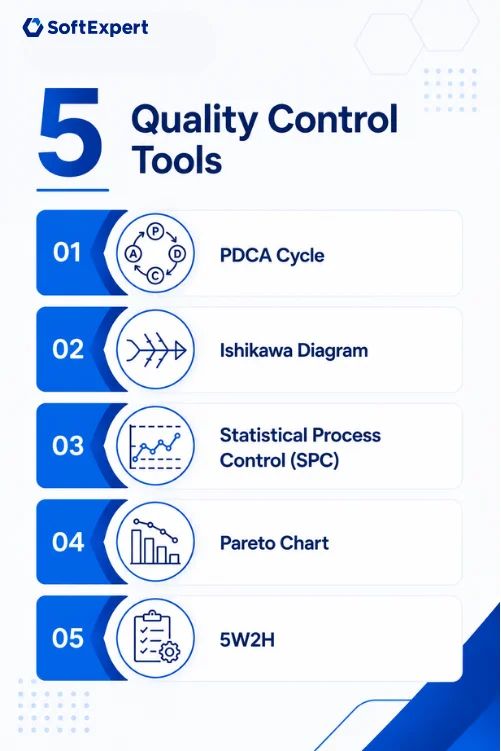
PDCA Cycle (Plan, Do, Check, Act)
This is the true engine of continuous improvement. The PDCA cycle involves planning an improvement (Plan), executing it on a small scale (Do), checking the results obtained (Check), and, if successful, standardizing the action (Act). It is the foundational philosophy behind total quality management.
Ishikawa Diagram (Fishbone Diagram)
Also known as the fishbone diagram, this is a visual tool used for root cause analysis. When a defect is detected, the diagram helps map out all possible causes that led to the event, categorizing them into core operational areas such as Machine, Manpower, Method, Material, Milieu/Environment, and Measurement (the 6 Ms).
Statistical Process Control (SPC)
SPC is essential for large-scale manufacturing. It utilizes sampling and control charts to monitor process behavior over time. The tool helps distinguish whether a variation in a piece of machinery is normal (due to random causes) or if a special cause is at play, allowing for adjustments before out-of-specification parts are ever produced.
Pareto Chart
Based on the 80/20 rule, this bar chart helps managers prioritize their efforts. It visually demonstrates the vital few causes (20%) that generate the vast majority of problems or defects (80%).
5W2H
This is a highly practical framework for executing corrective action plans. The 5W2H methodology involves answering seven key questions for any improvement initiative:
- What will be done?
- Why will it be done?
- Where will it take place?
- When will it happen?
- Who will perform it?
- How will it be executed?
- How much will it cost?
With these and other tools, you can build a highly precise, measurable industrial quality control system. This allows you to verify if the adopted measures are effective by tracking key performance indicators (KPIs) such as:
- Rework rate;
- Rejection rate;
- Volume of non-conformances;
- Turnaround time for corrective actions;
- Material loss percentage;
- Return rate;
- Compliance rate per batch;
- Process efficiency.
These indicators help build a crystal-clear view of operations. More importantly, they empower management to identify trends, benchmark historical periods, and make more informed decisions.
Quality Control in Industry 4.0
The transition away from manual spreadsheets, clipboards, and isolated visual checks into an era of deep digitalization marked the emergence of Quality 4.0. Modern industrial quality control is intrinsically linked to connectivity and data.
By leveraging technologies like the Internet of Things (IoT) and smart sensors embedded directly into assembly lines, the collection of data—such as temperature, vibration, thickness, or speed—occurs in real time. This allows systems to execute microscopic adjustments automatically, without human intervention.
Moving far beyond simply reacting to failures, Industry 4.0 enables predictive maintenance and advanced analytics. By cross-referencing massive volumes of historical production data, algorithms can forecast exactly when a machine will begin showing enough wear to produce defective items, recommending maintenance before the issue ever impacts product quality.
Furthermore, deploying unified quality control systems allows companies to centralize information, automate records, standardize workflows, track non-conformances, and monitor indicators in real time.
In practice, this minimizes data entry errors, drastically improves traceability, and facilitates cross-departmental integration. As a result, management can evaluate ongoing events much faster, identifying recurring patterns and taking preventive action.
How to Implement Industrial Quality Control in Your Operations?
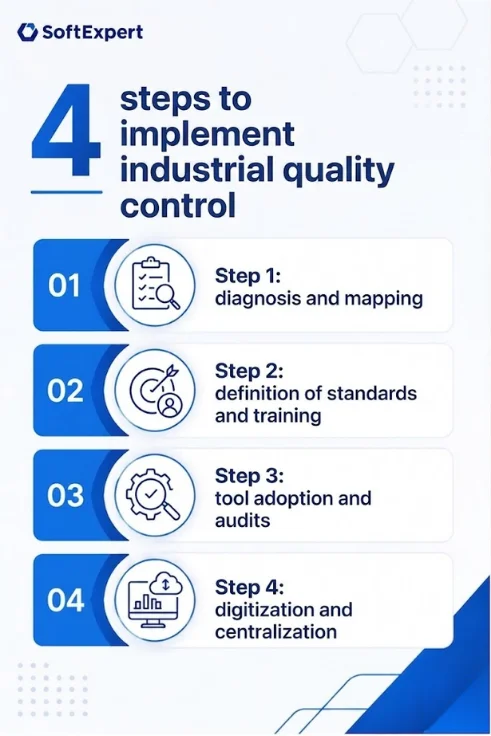
Transforming internal processes and culture requires a clear, pragmatic roadmap. If your industry needs to elevate its operational maturity level, follow this step-by-step approach:
Step 1: Diagnosis and Mapping
You cannot control what you do not measure. Therefore, the first step is to deeply map the current state of production processes, identify where the main quality bottlenecks live (measuring scrap rates, downtime, inspection failures, etc.), and define the KPIs that make sense for tracking progress.
Step 2: Defining Standards and Training
With the operational landscape mapped, it is time to document the ideal model. Establish clear, instructional, and accessible Standard Operating Procedures (SOPs). Most importantly: train your team exhaustively. Quality control must not be a forgotten policy on the wall; ensure that this culture is lived out by every operator on the shop floor.
Step 3: Tool Adoption and Audits
Next, initiate the practical application of the methodologies detailed above, such as deploying SPC on the most critical lines and using the Ishikawa diagram for any logged non-conformances. Implement a rigorous internal audit schedule to verify that standards are being upheld and to identify adjustment needs early on.
Step 4: Digitalization and Centralization
=Finally, it is fundamental to understand that managing industrial quality control via fragmented spreadsheets and emails is an open invitation for human error and regulatory liabilities. The definitive step toward true maturity is abandoning manual, decentralized controls. It is essential to adopt specialized quality management software that guarantees absolute data integrity, comprehensive batch traceability, and fluid approval workflows.
Conclusion
Industrial quality control has long ceased to be a mere isolated “inspection department” sitting at the end of the production line. Today, it stands as the central pillar supporting operational excellence, reducing the cost of poor quality, and driving corporate competitiveness within the global B2B market.
In sectors where regulatory bodies and tight margins do not forgive mistakes, a robust, digitalized process is a company’s best line of defense and offense. Securing this compliance and achieving continuous excellence does not have to be a manual, decentralized, or exhausting process.
Looking for more efficiency and compliance in your operations? Our experts can help identify the best strategies for your company with SoftExpert solutions. Contact us today!
FAQ: Industrial Quality Control
Industrial quality control is the set of practices, procedures, and tools used to verify that products, processes, and raw materials meet the standards defined by the company, regulatory legislation, and market requirements. It is a systematic framework of processes, inspections, metrics, and methodologies applied across the entire production chain, from raw material inspection to final product analysis.
Quality control is primarily reactive and product-focused, with the main goal of detecting flaws, isolating defective items, and ensuring they do not reach the end consumer. Quality management (or quality assurance), on the other hand, is the broader systemic umbrella; it is preventive, process-focused, and aims to ensure that defects are engineered out of the process entirely.
In manufacturing sectors, this management framework has become a baseline condition for keeping operations active and compliant. A robust control system reduces rework and waste, lowers raw material losses and machine downtime, increases operational efficiency, and improves production predictability. It also strengthens customer trust, streamlines audits, and accelerates continuous improvement.
Quality tools are practical instruments designed to analyze facts and drive data-backed decisions. The most widely used tools in industrial environments include the PDCA Cycle (Plan, Do, Check, Act), the Ishikawa (Fishbone) Diagram, Statistical Process Control (SPC), the Pareto Chart, and the 5W2H planning framework.
Industry 4.0 introduced deep digitalization, giving rise to Quality 4.0. Utilizing technologies like the Internet of Things (IoT) and smart sensors, data points such as temperature, vibration, or speed are collected in real time, allowing for automated adjustments without human intervention. It also unlocks predictive maintenance and advanced analytics to forecast machine wear before it leads to defective outputs.
To boost operational maturity, implementation follows four foundational steps. First, diagnose and map the current state while defining key KPIs. Second, establish clear standards using Standard Operating Procedures (SOPs) paired with extensive team training. Third, actively adopt quality tools and establish internal audits. Fourth, digitalize and centralize operations by adopting dedicated quality management software.